


The appointment is on the calendar. Somewhere in the back of your mind is the worry that you’ll sit through a long presentation, get to a number that expires at midnight, and sign something before you’ve had time to think.
Here’s the good news: you don’t need to win an argument. You need a handful of calm questions and a pen.
I write and measure these quotes for a living. Below are the exact questions I’d ask if I were sitting on your side of the table — grouped by what each answer actually tells you.
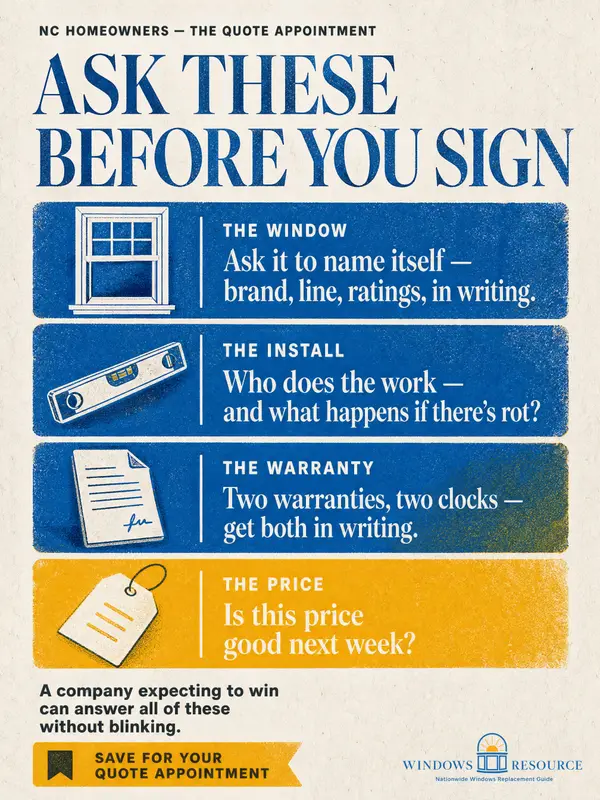
What should I ask a window company before I sign? Ask questions in four groups. The window: brand, line, U-factor, SHGC, and glass package, in writing. The install: who does it, insert or full-frame, and what happens if they find rot. The warranty: the product warranty AND the labor warranty, separately. The price: itemized, and whether it’s still good next week. A company expecting to win can answer all four without blinking.
What should I actually ask a window company?
Ask questions that make the quote name itself. A vague quote survives on adjectives — “premium,” “top-of-the-line,” “lifetime.” A comparable quote survives on nouns and numbers: a brand, a line, a U-factor, a payment schedule.
Every question below does one job — it turns an adjective into something you can write down and compare against the next company’s answer. None of them is confrontational. They’re the questions any good rep can answer in a sentence.
The questions about the window itself
Make the window tell you its name and its numbers. “A great window” is not a spec. A brand, a line, and the two numbers off the label are.
- “What’s the brand and line — the exact model?” ENERGY STAR’s own buying guidance says an estimate should name the brand and model, not just a category.
- “What’s the U-factor and SHGC on this window, in writing?” These are the two numbers that tell you how the window performs in our climate. If a quote can’t produce them, it can’t be compared to anything. Here’s how to read them off the label.
- “What’s in the glass package?” coating, argon fill, double- or triple-pane. In most of North Carolina the coatings that manage summer heat matter more than chasing the lowest number.
The questions about the install
The window is half the purchase. The install is the other half — and it’s the half that leaks a year later. A great window sealed badly still lets water into the wall.
- “Who actually installs it — your crews or subcontractors?” Either can be excellent. You’re just establishing who stands behind the work and who you’ll call if something’s off.
- “Is this an insert or a full-frame replacement?” An insert drops the new window into your sound existing frame. A full-frame tears back to the rough opening — the right call when the sill or surrounding wood is rotted. They’re different jobs at different prices, and you want to know which one you’re buying.
- “What happens if you open it up and find rot?” This is the question that separates a firm price from a surprise. A company that handles this routinely will tell you exactly how a change gets priced before they proceed.
The questions about the warranty
There are two warranties, on two different clocks — and homeowners get hurt by conflating them. The manufacturer covers the product. The installer covers the workmanship.
- “What’s the product warranty AND the labor warranty — separately, in writing?” The product warranty runs long (often 10–25 years by component). The labor warranty is frequently just one to several years, and an install fault is the more common early failure.
- “When the fine print says ‘lifetime,’ whose lifetime, and which parts?” “Lifetime” usually means the product’s expected lifespan, not yours, and it’s often split — frame, glass, and hardware on different clocks. The FTC requires the term be defined, so ask to see the definition.
- “Is it transferable if I sell the house?” A transferable warranty adds resale value, but it often requires written notice within a set window and may prorate after transfer. Worth knowing now, not at closing.
The questions about the price and terms
Re-anchor every conversation on the total project cost, itemized — not the monthly payment. “Just $200 a month” answers a different question than “what does this cost.”
- “Can I get this itemized, line by line?” Each window unit, labor, trim and sealants, old-window disposal, permits, both warranties, and a timeline. A revised itemized quote is a normal request, not a difficult one.
- “Is this price good next week?” A real number for real work is still real in seven days. The lists offers that are “only good today” among its classic warning signs to slow down on.
- “What’s the deposit, and what triggers each payment after it?” North Carolina sets no statutory cap on home-improvement deposits — it’s negotiated. Consumer-protection guidance commonly points to a modest deposit (often cited around 10%) with the rest tied to milestones; a request for 50% or more upfront is a commonly cited caution worth asking about.
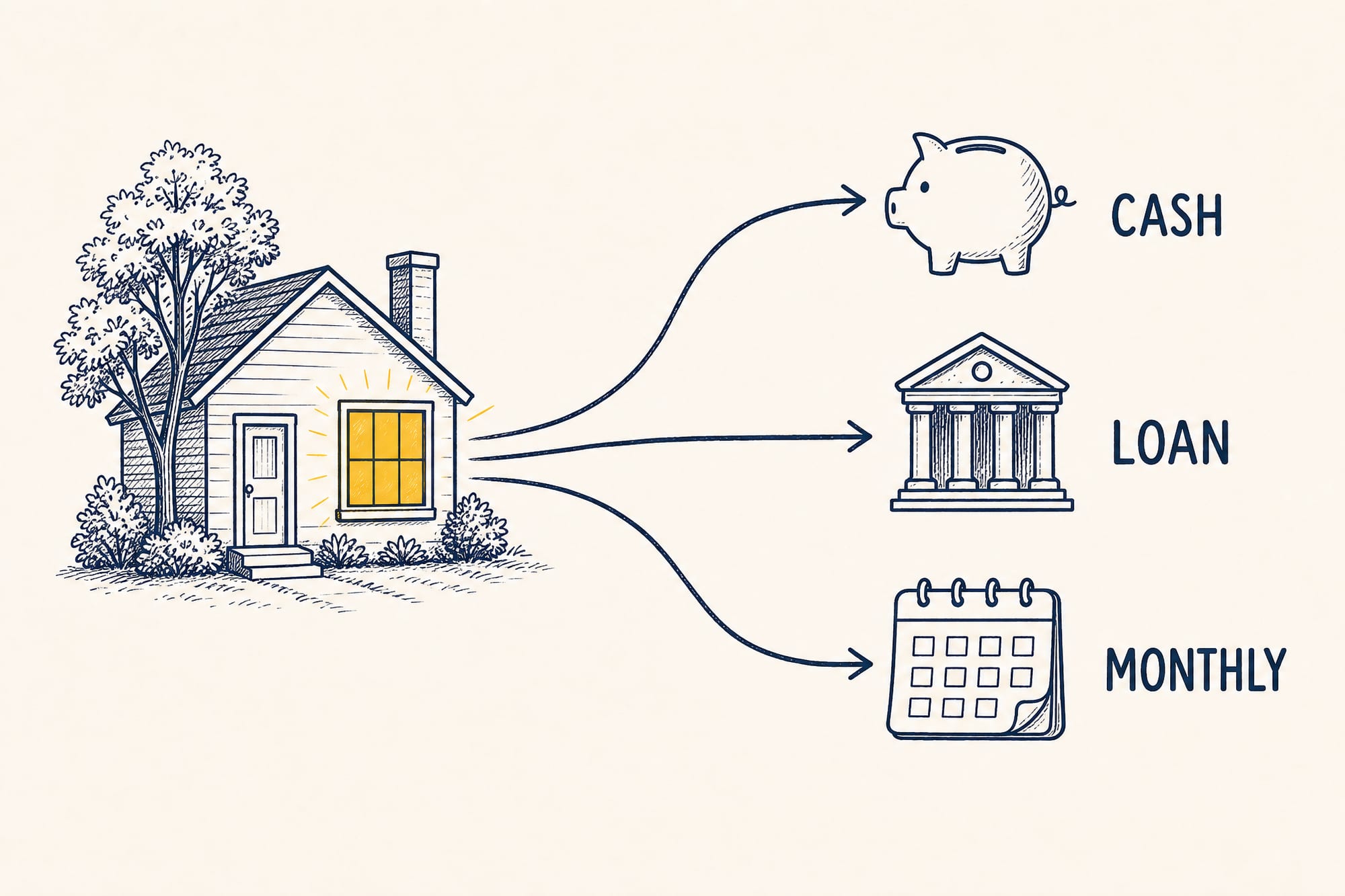
- “What’s the cash price versus the financed total?” If financing is on the table, ask whether a “0% ” offer is true 0% or a deferred-interest plan — the honest financing picture is here.
The one question about the company
“Who answers the phone in year three?” A window is a decade-plus purchase. The company that installs it should still be reachable when a sash needs adjusting or a seal fails under warranty.
Two quick ones that go with it: “Can I see a couple of recent local jobs or references?” and “Who pulls the permit, and is it a line item?” In North Carolina, permit handling turns on scope and the state’s $40,000 threshold — who pulls the permit is covered here. You’re not checking the code. You’re checking whether the company handles it openly.
What a clear answer sounds like (and what deserves one more question)
A confident quote answers in nouns and numbers. A shaky one answers in adjectives. That’s the whole tell — and it’s a comment on the answer, never on the person giving it.
Hold each answer you get against this. Where the middle column lands, you’re set. Where the right column lands, you’ve just found your next question.
| What you're asking | A clear answer names… | An answer worth one more question |
|---|---|---|
| The window | Brand, line, U-factor, SHGC, glass package — in writing | "Top-of-the-line, best on the market" with no numbers |
| The install | Insert vs full-frame, who installs, how rot gets priced | "Don't worry, our guys handle everything" |
| The warranty | Product AND labor warranty, each with its term, in writing | "It's a lifetime warranty" — undefined, one document |
| The price | Itemized; a dated price that holds for a stated period | One lump sum, good only tonight |
| The company | Recent local references; who answers in year three | "We've been around forever" with nothing to show |
The window
- A clear answer names…
- Brand, line, U-factor, SHGC, glass package — in writing
- An answer worth one more question
- "Top-of-the-line, best on the market" with no numbers
The install
- A clear answer names…
- Insert vs full-frame, who installs, how rot gets priced
- An answer worth one more question
- "Don't worry, our guys handle everything"
The warranty
- A clear answer names…
- Product AND labor warranty, each with its term, in writing
- An answer worth one more question
- "It's a lifetime warranty" — undefined, one document
The price
- A clear answer names…
- Itemized; a dated price that holds for a stated period
- An answer worth one more question
- One lump sum, good only tonight
The company
- A clear answer names…
- Recent local references; who answers in year three
- An answer worth one more question
- "We've been around forever" with nothing to show
Copy these into your phone
Here’s the whole page as a list you can read back at the table. No memorizing. Pull out your phone, read them one at a time, and write down what you hear.
The 7 questions to ask before you sign
- “What’s the exact brand, line, U-factor, and SHGC — in writing?”
- “Is this an insert or a full-frame install, and how does rot get priced if you find it?”
- “What are the product warranty AND the labor warranty, separately?”
- “Can I get this itemized, line by line?”
- “Is this price good next week?”
- “What’s the deposit, and what triggers each payment after it?”
- “Who answers the phone in year three?”
Seven clear answers and you’ve got a quote you can compare. Any hesitation just tells you what to ask about next.
Once you’ve got answers from two or three companies in that shape, the comparison almost runs itself: normalize each to a per-window installed price and sanity-check the number against NC ranges, then overlay the quote red flags to see what’s missing. The full buyer’s playbook ties it all together.
And if you’d like a second set of eyes before you sign — someone who reads these documents daily — that’s exactly what a no-pressure second opinion on your quote is for. Bring the answers you got; I’ll tell you which ones are solid and what to ask next!
Sources, Verification & Fact-Checking verified July 2026
Every load-bearing fact on this page is sourced and verified against a primary authority.
Verified July 2026 via direct review of the cited authority — the links open the controlling source so you can check it yourself rather than take our word.
- Get several itemized quotes naming brand, model, U-factor, and SHGC, with labor and materials broken out: ENERGY STAR’s replacement-window buying guidance. (view source — ENERGY STAR buying tips)
- “Only good today” offers are a classic warning sign to slow down on: Consumer Financial Protection Bureau consumer guidance — cited as the reason a durable price is the baseline, not as a claim about any company. (view source — CFPB)
- Two separate warranties (manufacturer product warranty vs installer labor warranty), typical lengths, and the “lifetime”/“limited”/transferable fine print: consistent with ENERGY STAR’s product/glass/installation warranty framing at the link above; separately, the FTC requires a “lifetime” claim to define whose life or what period it covers. (view source — FTC, Businessperson’s Guide to Federal Warranty Law)
- Insert vs full-frame replacement and the rot rule (full-frame is the correct call when the sill or surrounding wood is rotted): standard fenestration-installation practice; correct-installation methods are documented in U.S. Department of Energy building-science guidance. (view source — U.S. Dept. of Energy, correct window installation)
- Deposit norms: North Carolina sets no statutory percentage cap on home-improvement deposits; it is a negotiated figure. Consumer-protection guidance commonly cites a modest deposit (often around 10%) as reasonable, with milestone-based payment for the remainder, and flags requests for 50%+ upfront as a caution sign. (view source — NC Department of Justice, Consumer Protection)
- The “is this price good next week?” forum account is a homeowner-shared story, retold here as reported — illustrative of the anchor-and-discount structure and the “call the manager” tactic, not a verified price or a claim about any named company.
- NC permit threshold ($40,000) and financing “0% APR” / deferred-interest mechanics: covered in depth, with citations, on the site’s NC window permits and financing pages — linked in the body rather than restated here.