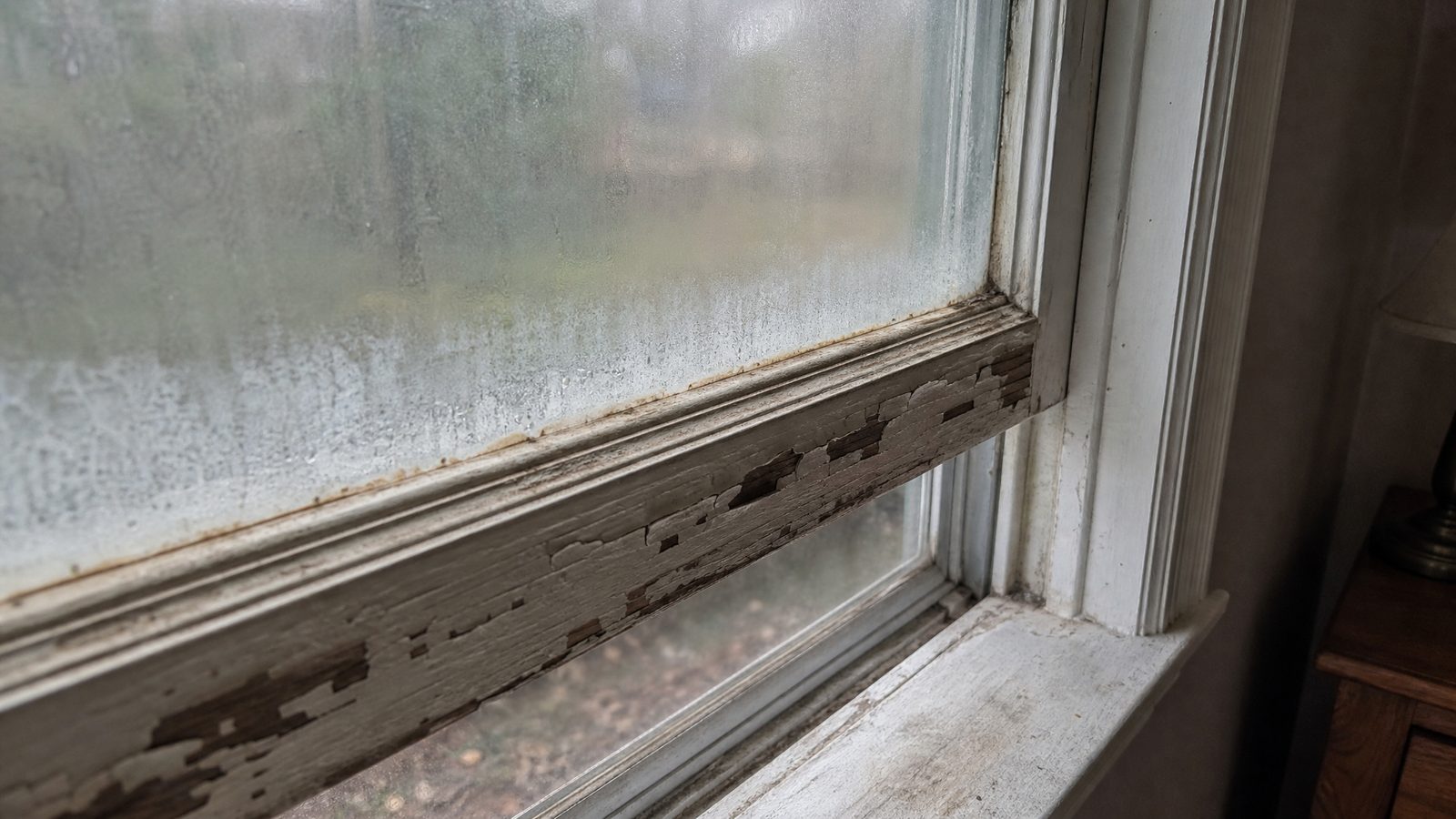



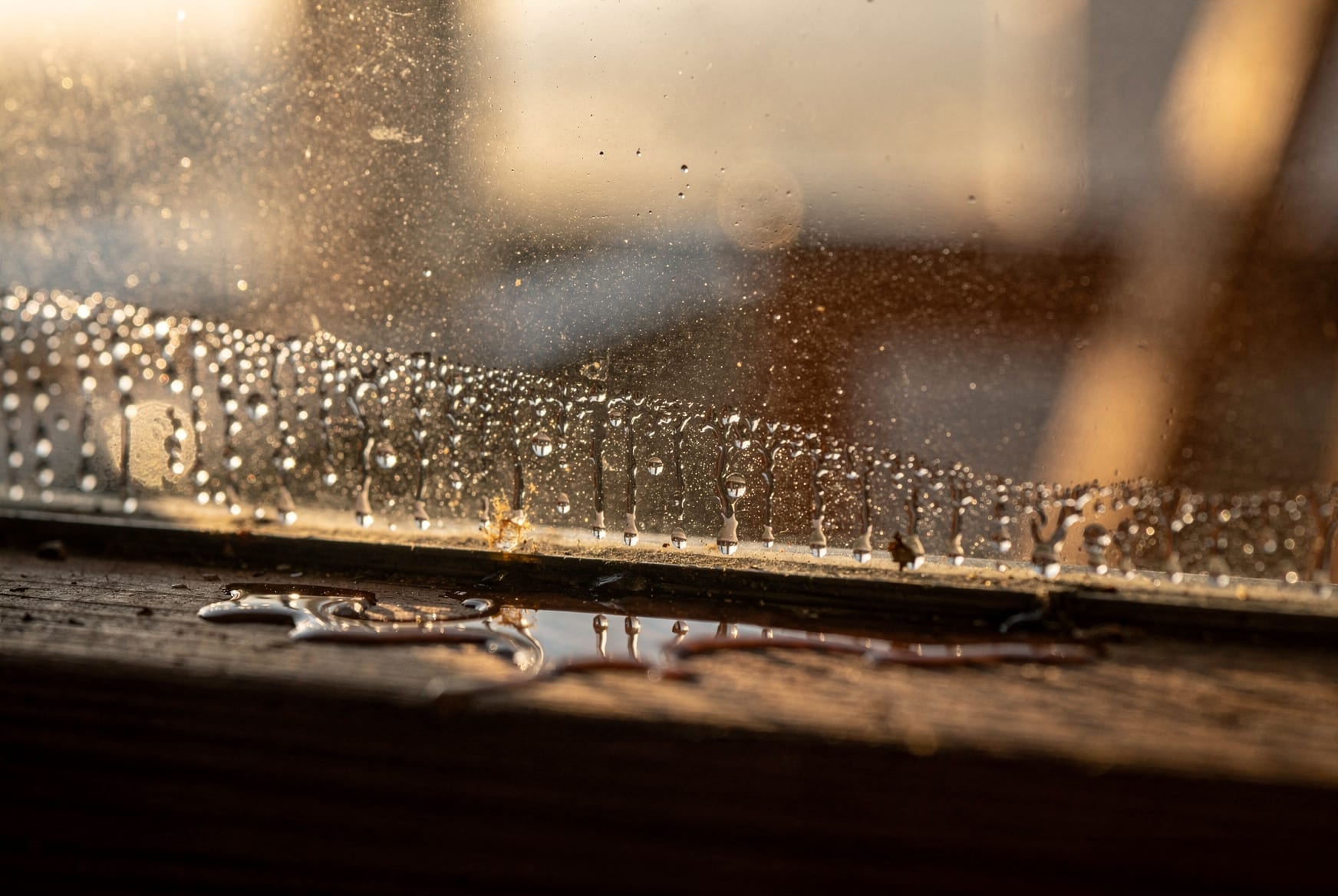
You wiped the sill again this morning. That’s twice this week, and somewhere in the back of your mind a number is forming — the cost of replacing every window in the house.
Here’s the part no one leads with: there are three kinds of window condensation, and only one of them is the window’s fault.
Which one do you have? Do a wipe test. Inside surface (wipes off from indoors) is your indoor humidity. Between the panes (no side wipes it) is a failed seal. Outside surface (wipes off outdoors) is dew — and it’s a good sign.
Thirty seconds with a cloth tells you which of the three you’re looking at. Let’s sort it.
The 30-second test: which side is the moisture on?
Wipe the glass indoors. If that clears it, it’s indoor humidity. Wipe it outdoors. If that clears it, it’s dew. If neither side clears it, the seal is dead. That’s the whole diagnosis.
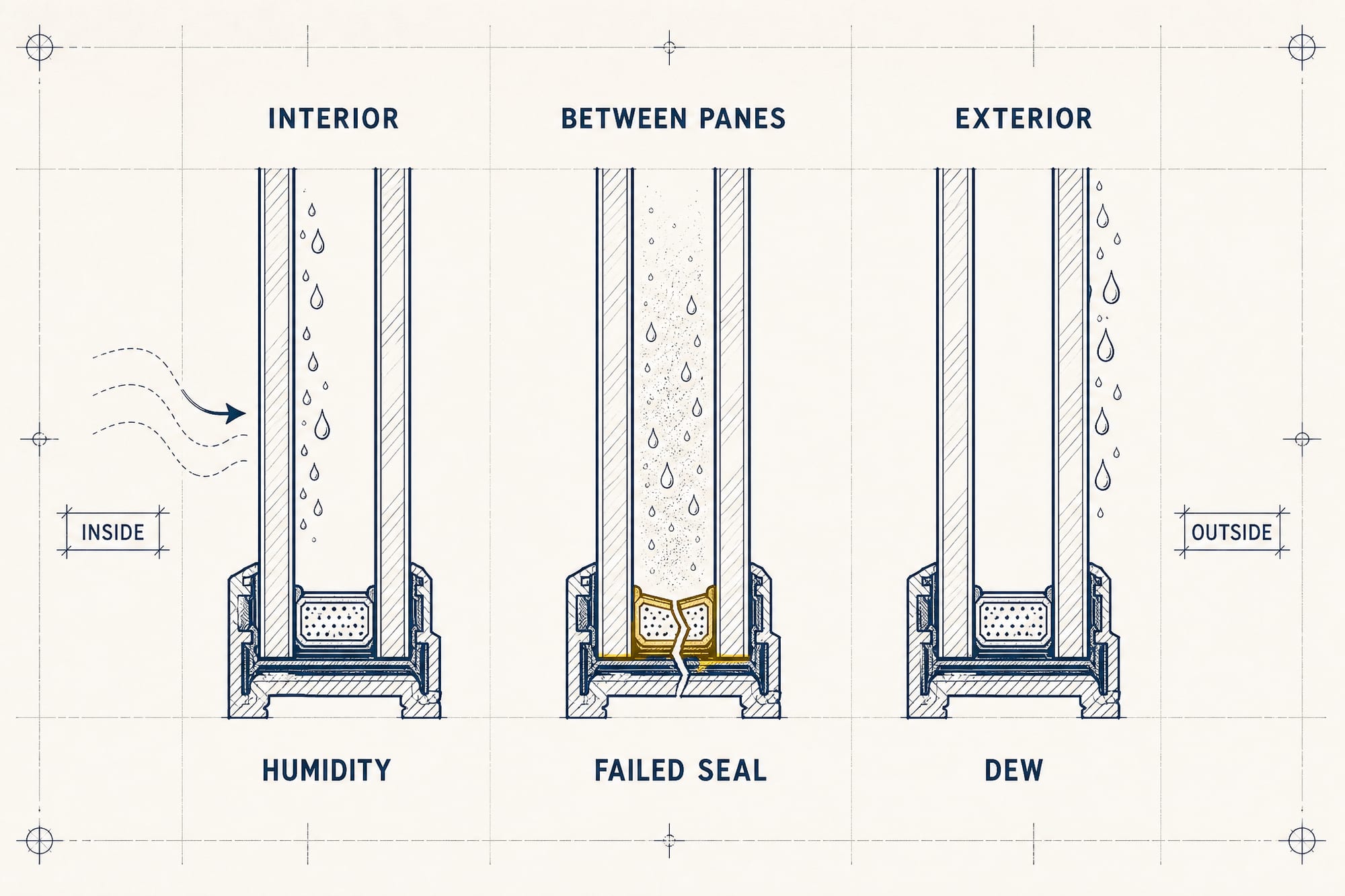
Here’s the same thing as a table you can hold your window up against.
| Where the moisture is | What it's telling you | The window's fault? | What to do |
|---|---|---|---|
| On the inside surface (wipes off indoors) | Humid indoor air meeting cool glass | Usually not | Manage humidity and airflow |
| Between the panes (no side wipes it) | The sealed unit's edge seal has failed | Yes — the unit is done | Swap the glass unit; see the foggy page |
| On the outside surface (wipes off outdoors) | Your glass insulates well; the outer pane runs cool | No — it's a good sign | Nothing. It clears by mid-morning |
On the inside surface (wipes off indoors)
- What it's telling you
- Humid indoor air meeting cool glass
- The window's fault?
- Usually not
- What to do
- Manage humidity and airflow
Between the panes (no side wipes it)
- What it's telling you
- The sealed unit's edge seal has failed
- The window's fault?
- Yes — the unit is done
- What to do
- Swap the glass unit; see the foggy page
On the outside surface (wipes off outdoors)
- What it's telling you
- Your glass insulates well; the outer pane runs cool
- The window's fault?
- No — it's a good sign
- What to do
- Nothing. It clears by mid-morning
If your test landed between the panes, stop here and go to foggy windows — repair or replace. Nothing else on this page will help that one.
Everyone else: the rest of this is about the room-side kind, which is the common one and the fixable one.
Why the glass and not the wall
Air holds a certain amount of water vapor, and the warmer it is, the more it can hold. Cool that air down far enough and it hits the point where it can’t hold what it’s carrying, so the excess comes out as liquid. That temperature is the dew point.
Your walls are insulated. Your glass is not, at least not to the same degree — even good glass is the weakest thermal link in the room. So the glass runs colder than everything around it, and it’s the first surface in the room to drop below the dew point.
That’s why the window sweats and the drywall beside it doesn’t. The window isn’t failing. It’s just first.
Why it starts at the edges
Look closely at where the water actually sits. This is the most useful thing on the whole window, and almost nobody tells you to check it.
Two panes of glass are held apart by a spacer — a thin strip running around the perimeter that seals the unit and sets the gap. On older units that spacer is aluminum, and aluminum conducts heat extremely well. That makes the perimeter of the glass a cold rim: it runs colder than the center of the pane, so it reaches the dew point first.
So the pattern tells you the cause:
- Water across the whole pane — your indoor humidity is high. Start with lever 1.
- Water ringing the perimeter, center clear — the spacer is the cold spot. Lever 2.
- Water on the frame itself — the frame is a cold bridge. Lever 3.
Three patterns, three different answers. Now work them in order — because the first one is free.
Lever 1: lower the indoor humidity (the free fix)
This is the fix in the large majority of cases, and it costs nothing. Before you price a single window, find out how much water your house is putting into its own air.
More than you’d guess. North Dakota State University Extension puts it at three pints of water vapor per person, per day, just from breathing. Add showers, cooking, and dishwashing, and the NFRC’s consumer resource notes a household can add over a gallon a day. The University of Minnesota Extension’s list runs longer still: bathing, cooking, dishwashing, humidifiers, stored firewood, plumbing leaks, unvented appliances, and damp soil under a basement or crawlspace.
Newer, tighter homes see more of this, not less — less of that moist air leaks out on its own. A well-sealed house holds onto its warmth and its humidity with equal devotion.
What actually moves the needle:
- Vent to the outside, not the attic. ENERGY STAR: vent dryers directly outside, and make sure kitchen and bath fans do too. NDSU flags the classic failure — a fan that dumps into the attic isn’t removing anything from the house.
- Run the fan 20 minutes past the shower. Not “a few minutes.” ENERGY STAR’s guidance is to leave it running for 20 minutes after you’re done, and that’s the difference between exhausting the moisture and just stirring it.
- Turn the humidifier down. Especially a whole-house unit set and forgotten.
- Let air move across the glass. Open the drapes at night. Heavy closed curtains and deep blinds trap the glass on the cold side of the room’s air, which makes it colder still.
- Air it out. UMN Extension: in winter, open windows slightly for a few minutes to trade warm moist indoor air for cold dry outdoor air. It sounds wasteful. It works.
- For a very tight house, consider mechanical ventilation. An air-to-air exchanger (HRV or ERV) brings in fresh air while recovering most of the heat.
So what humidity should I actually run?
Here the honest answer is that the authorities disagree, and it’s worth knowing why rather than being handed one number.
- The EPA says keep indoor humidity below 60%, ideally 30–50%. That’s a year-round health and mold band.
- University of Minnesota Extension says roughly 25% in winter, 50% in summer.
- North Dakota State University Extension gives a winter target of 40% — higher and you risk condensation, lower and the air gets uncomfortably dry.
They’re not contradicting each other so much as answering different questions, and the extension numbers run lower because they’re specifically about cold-weather glass.
The rule underneath all of them: the colder it is outside, the lower your indoor humidity has to run before the glass stops sweating. A level that’s fine in October will sweat the windows at 5°F.
The industry’s own version of that rule is a sliding scale. This is from the Fenestration and Glazing Industry Alliance — the standards body behind the AAMA specifications — and it assumes an indoor air temperature of 70°F (20°C), which is the part that makes the numbers mean anything:
| Outdoor air temperature | Also (°C) | Keep indoor humidity at or below |
|---|---|---|
| 20° to 40°F | −7° to 4°C | 40% |
| 10° to 20°F | −12° to −7°C | 35% |
| 0° to 10°F | −18° to −12°C | 30% |
| −10° to 0°F | −23° to −18°C | 25% |
| −20° to −10°F | −29° to −23°C | 20% |
| Below −20°F | Below −29°C | 15% |
20° to 40°F
- Also (°C)
- −7° to 4°C
- Keep indoor humidity at or below
- 40%
10° to 20°F
- Also (°C)
- −12° to −7°C
- Keep indoor humidity at or below
- 35%
0° to 10°F
- Also (°C)
- −18° to −12°C
- Keep indoor humidity at or below
- 30%
−10° to 0°F
- Also (°C)
- −23° to −18°C
- Keep indoor humidity at or below
- 25%
−20° to −10°F
- Also (°C)
- −29° to −23°C
- Keep indoor humidity at or below
- 20%
Below −20°F
- Also (°C)
- Below −29°C
- Keep indoor humidity at or below
- 15%
Read it as a ceiling, not a target — these are maximums to stay under, and they drop fast as it gets colder. If your house sits at 45% all winter and the glass sweats every time it drops below freezing, that table is the reason.
Two honest caveats. It assumes 70°F indoors, so a cooler house shifts it. And it’s guidance for a typical window — your actual glass could be warmer or colder than average depending on the spacer, the glass package, and the frame, which is what the next two levers are about.
So rather than chasing one number: find your outdoor temperature on that table, get under the humidity beside it, and watch the glass. Your windows are the gauge.
Lever 2: raise the glass temperature
If humidity is under control and the glass still sweats — especially in a ring around the edges — the other side of the equation is the surface temperature. Warmer glass stays above the dew point across a much wider range of conditions.
Three sub-levers, in the order they matter:
1. A warm-edge spacer instead of aluminum. The highest-leverage single change, because the perimeter is where it starts. A warm-edge spacer uses a less conductive material, which lifts the temperature of the glass edge and takes away the cold rim that was collecting water.
2. A better glass package. More panes, a Low-E coating, and an argon fill all raise the room-side surface temperature. NDSU Extension gives the clearest illustration I could source: at 40% indoor humidity, condensation appears on a double-pane window once it’s around 0°F outside, while on triple-pane it doesn’t show until roughly −40°F.
That’s a dramatic shift in the threshold — and notice what it is not. It isn’t “no condensation ever.” It’s the same house can hold more humidity before the glass sweats. (It’s also a cold-climate data point; it illustrates the mechanism rather than prescribing triple-pane for everyone.)
3. A warmer frame. Which brings us to the third lever.
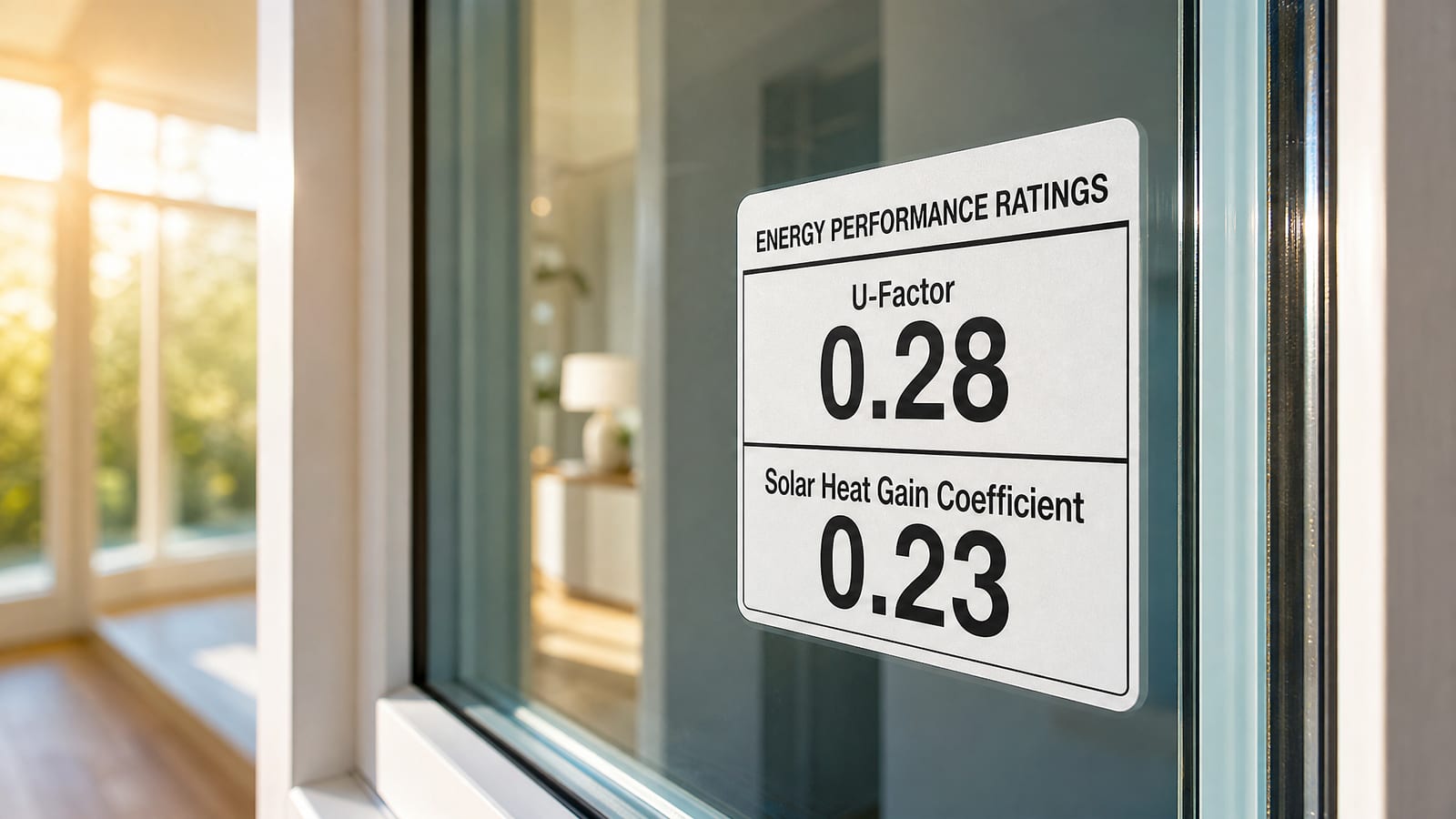
The same things that lower a window’s U-factor raise its room-side surface temperature — they’re two views of the same property. If you want that decoded properly, it’s on the U-factor and SHGC page.
Lever 3: when the frame is the cold bridge
If the water is on the frame rather than the glass, the frame is conducting cold straight through the wall to the inside face.
The usual culprit is old aluminum without a thermal break. Aluminum is strong and slim and a superb conductor of heat, which is exactly what you don’t want in a window frame. There’s no humidity setting that fixes a frame running near outdoor temperature on its interior face.
This is the one branch where replacement is the honest answer. Not because a salesman said so, but because you’ve now ruled out the two cheaper explanations and the material itself is the problem. A thermally broken or non-metal frame is a different animal.
Ice on the inside of the glass
Same mechanism, one step further.
When the room-side glass is below the dew point and below freezing, the moisture doesn’t bead — it deposits directly as frost or ice. That’s why a bedroom window can carry a rim of ice along the bottom of the glass on a cold morning while the rest of the pane just looks wet.
It reads as alarming and it means the same thing the water meant: indoor humidity is high relative to how cold that glass surface is running. Work the same levers in the same order. Ice is not a different problem; it’s the same problem with the thermostat of the outdoors turned down.
The one thing worth acting on quickly is where it melts. Ice along the bottom rail melts into the sill and sits there, and standing water on a sill through a whole winter is how a humidity problem eventually becomes a rot problem.
The CR rating, and what it won’t tell you
If you’re shopping and sweating glass is your worry, there’s a number for it: Condensation Resistance, or CR, on the label. A higher number means the window resists interior moisture better.
Three things about it that the average product page leaves out:
It’s optional. Manufacturers don’t have to report it, so plenty of labels don’t carry it at all. If it matters to you, ask for it specifically.
It’s set by the weakest part of the window. NFRC measures room-side surface temperature across three separate areas — center-of-glazing, edge-of-glazing, and frame. The rating reflects the worst performer of the three. Which is exactly why the spacer matters so much: on a lot of windows, the edge is what’s dragging the number down.
It’s relative, not a prediction. NFRC is explicit that CR is meant to compare products, not to tell you whether a given window will sweat at your humidity and your outdoor temperature. The University of Utah’s TP3C testing found window systems with similar CR values that performed drastically differently from one another.
So: worth asking for, worth comparing between two quotes, and not worth treating as a guarantee.
Will new windows stop it?
This is the question the whole page has been walking toward, and it deserves a straight answer.
No. They reduce it substantially. Nothing stops it.
ENERGY STAR says so in its own guidance, which is worth quoting exactly because it comes from the program whose label is on the window:
The NFRC makes the physical version of the same point: at 100% relative humidity, moisture will form on almost any surface, whatever its temperature. No product outruns saturated air.
The accurate way to describe what better windows buy you: they raise the interior glass temperature, which lets your house hold more humidity before the glass sweats. They move the threshold. That’s genuinely valuable — it’s the difference between a window that beads up every cold morning and one that only does it during a hard freeze. It just isn’t the same thing as making the problem disappear.
There’s no such thing as a window that can’t sweat — only windows that sweat under narrower and narrower conditions. That’s worth paying for. It’s just worth knowing what you’re buying.
Fog between the panes: this one is the seal
If no side wipes it clean, the moisture is sealed inside the glass — and that means the unit’s edge seal failed. The gas fill escaped, humid air crept in, the drying agent saturated, and now it condenses where no cloth can reach.
That’s the one kind that’s genuinely the window’s fault. The good news is it’s often a repair rather than a replacement: in a sound frame, a glazier can swap just the sealed glass unit.
The full diagnosis lives on its own page — foggy windows, repair or replace.
Dew on the outside: that’s actually good news
Condensation on the outside pane is a sign your windows are working, not failing. It throws people every time.
There are two ways it happens, and both mean the same thing.
On a clear, calm night, the outer glass radiates its heat up to the sky and cools below the dew point — the same way dew forms on your car and the lawn. A good IGU with Low-E and argon insulates so well that interior heat barely reaches that outer pane to warm it back up.
The other case runs in the opposite season. On a hot, humid day, as ENERGY STAR describes it, the cool air inside an air-conditioned house can pull the outside surface of the glass below the outdoor dew point — and the muggy outdoor air condenses on it.
Either way, exterior dew means the outer pane is running cool because your glass is doing its job. It wipes off from outdoors and burns off as the day warms. There’s nothing to fix.
So what do I actually do?
Wipe test first, then work the levers in order:
- Between the panes — the seal’s dead. Price a glass-unit swap before a whole window (foggy, diagnosed).
- Outside — pour a coffee and enjoy it. Nothing’s wrong.
- Inside, across the whole pane — lever 1. Lower the humidity. It’s free and it usually works.
- Inside, ringing the edges — lever 2. The spacer is your cold spot.
- Inside, on the frame — lever 3. A cold-bridging frame is the one case where replacement is the honest answer.
The one worth watching is persistent interior sweating, because moisture that sits on the sill all winter can eventually rot the frame — and that is how an easy problem becomes an expensive one.
Your hope walking in was that the sweating glass didn’t mean a house full of new windows. Two times out of three, you’re right — and in the third case, you’ll now know exactly which part of the window to point at.
Not sure which of the three you’ve got? Send me a photo of the glass and where the water sits, and I’ll tell you whether it’s your humidity, your spacer, or a failed seal — no pressure, no sales script.
Sources, Verification & Fact-Checking verified July 2026
Every load-bearing fact on this page is sourced and verified against a primary authority.
Verified July 2026 via direct review of the cited authority — the links open the controlling source so you can check it yourself rather than take our word.
- Condensation on the interior surface of a window is humid indoor air condensing on cool glass — a humidity and ventilation issue, not a window defect. It appears on the glass first because the glass is typically the coldest interior surface. (view source — ENERGY STAR, residential windows, doors & skylights)
- Better windows reduce condensation but do not eliminate it. ENERGY STAR states that certified windows “are more resistant to condensation, but even they can suffer from it in cold weather.” The NFRC adds that at 100% relative humidity, moisture will form on almost any surface regardless of its temperature. (view source — ENERGY STAR · view source — NFRC condensation resistance fact sheet)
- Condensation Resistance (CR) is an optional NFRC rating measured across three component areas — center-of-glazing, edge-of-glazing, and frame — and provides a relative comparison between products rather than a prediction for a specific home. (view source — NFRC condensation resistance fact sheet · view source — NFRC consumer guide to window ratings)
- Windows with similar CR values can perform differently in practice. University of Utah TP3C condensation testing found window systems with comparable CR ratings that performed drastically differently from one another. (view source — University of Utah TP3C condensation study)
- Recommended indoor humidity levels differ by source because they answer different questions. EPA advises keeping indoor humidity below 60%, ideally 30–50%, as a year-round mold and health guideline; University of Minnesota Extension gives roughly 25% in winter; North Dakota State University Extension gives a winter target of 40%. (view source — EPA, mold, moisture and your home · view source — UMN Extension · view source — NDSU Extension)
- Recommended maximum indoor relative humidity falls as the outdoor temperature drops — 40% at 20–40°F, 30% at 0–10°F, and 15% below −20°F, assuming an indoor air temperature of 70°F (20°C). Published by the Fenestration and Glazing Industry Alliance (FGIA, the AAMA standards body), which credits the Home Energy Resource of Minnesota and the CSA A440.2 User Guide. (view source — FGIA, understanding indoor condensation)
- Everyday household activity adds substantial moisture to indoor air. NDSU Extension estimates each person adds about 3 pints of water vapor daily through breathing; sources of indoor moisture include bathing, cooking, dishwashing, humidifiers, unvented appliances, and damp soil beneath basements and crawlspaces. (view source — NDSU Extension · view source — UMN Extension)
- Exhaust fans should vent outside, and should run for 20 minutes after showering or cooking. ENERGY STAR advises venting dryers and kitchen and bath fans directly outside and leaving fans running for 20 minutes after use. (view source — ENERGY STAR)
- Fog or moisture trapped between the panes that no cloth reaches means the sealed insulated glass unit’s edge seal has failed. The gas fill escapes and humid air enters; the unit has lost its seal and most of its insulating value. (view source — U.S. Dept. of Energy, Building Science Education)
- Condensation on the exterior surface of an efficient window is normal and indicates the glass is insulating well. It occurs both when the outer pane radiates heat to a clear night sky and when cool indoor air on a hot, humid day drops the outer surface below the outdoor dew point. (view source — ENERGY STAR)