

There is a number on every window quote in Idaho that decides how the room feels in January, and almost nobody reading the quote knows what it should be.
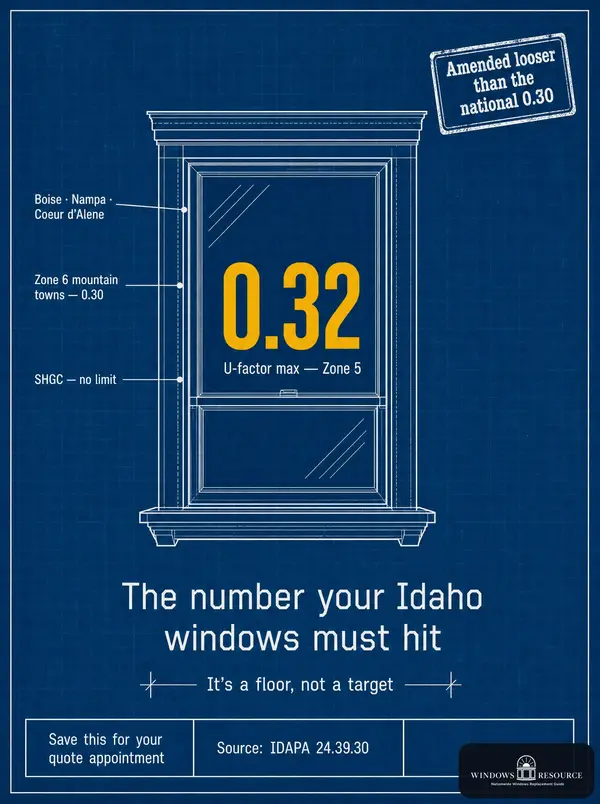
Here it is, straight, from the state’s own adopted rule: a U-factor of 0.32 in Climate Zone 5, and 0.30 in Climate Zone 6.
And here is the part the brochures leave out — that number is a floor, and in Idaho it is a surprisingly low one.
What the code actually requires
Idaho runs an amended version of the 2018 IECC. The amendment replaces two rows of the insulation and fenestration table, and this is what it replaces them with:
| Climate zone | Window U-factor (max) | Skylight U-factor (max) | SHGC |
|---|---|---|---|
| Zone 5 (most of Idaho, incl. Boise and Coeur d'Alene) | 0.32 | 0.55 | Not required |
| Zone 6 (higher elevation + north panhandle) | 0.30 | 0.55 | Not required |
Zone 5 (most of Idaho, incl. Boise and Coeur d'Alene)
- Window U-factor (max)
- 0.32
- Skylight U-factor (max)
- 0.55
- SHGC
- Not required
Zone 6 (higher elevation + north panhandle)
- Window U-factor (max)
- 0.30
- Skylight U-factor (max)
- 0.55
- SHGC
- Not required
Two things to take from that table, because they run against what most people assume.
Idaho made its own code looser, not stricter
The national 2018 IECC baseline for Climate Zone 5 is 0.30. Idaho amended it to 0.32.
That is not a typo and it is not a rounding difference — the state deliberately moved its Zone 5 requirement up, which means easier to meet. Zone 6 stayed at the national 0.30.
So if anyone tells you Idaho has a demanding window code because it gets cold here, that’s backwards. The honest framing is the one that matters when you’re comparing quotes: the code minimum is the least the law allows, and in Zone 5 Idaho asks for less than the national baseline.
That isn’t a knock on anyone quoting you. “Meets code” is a true statement, and most people saying it mean it as reassurance. It just answers a narrower question than the one you’re actually asking.
A window at exactly 0.32 is legal. It is not, in a state where the Treasure Valley sees single digits and McCall sees far worse, an especially good window.
There is no SHGC requirement at all
The solar-heat-gain column in Idaho’s table reads NR — not required.
That means the code sets no ceiling and no floor on how much solar heat your glass lets through. Nothing to comply with, in either direction.
This is worth pausing on if you’ve read window advice written for the South, where capping SHGC low is the whole game — the goal there is keeping summer sun out. Idaho’s problem is the opposite season. Here, solar gain through a south-facing window is free winter heat, and a low-SHGC glass package chosen out of habit gives that away for a summer problem you may not have.
Because the code is silent, this becomes a decision you make deliberately rather than one the inspector makes for you. That’s a good thing — as long as somebody actually makes it.
Which zone are you in? Idaho has exactly two
Idaho is a two-zone state: 5B and 6B. If you’ve seen a guide that puts parts of Idaho in Zone 7, it’s wrong — no Idaho county is assigned to Zone 7.
Most of the population is in Zone 5B: Ada County (Boise, Meridian, Eagle), Canyon County (Nampa, Caldwell), Kootenai County (Coeur d’Alene, Post Falls), and Nez Perce County (Lewiston).
Zone 6B covers the colder ground: Valley County (McCall), Blaine County (Ketchum and Sun Valley), and — the nuance that catches people out — Bonner and Boundary counties in the far north, even though neighbouring Kootenai County just south of them is 5B. The panhandle is genuinely mixed, so “north Idaho” is not a zone.
One more thing worth knowing if you’re shopping ENERGY STAR: every ZIP code in Idaho falls in the ENERGY STAR “Northern” zone. Whatever county you’re in, the Northern criteria are the ones that apply to your certified windows.
The 2024 code isn’t here yet — and your city can’t jump ahead
The 2024 I-Codes have moved through agency rulemaking in Idaho but are not in force. The amended 2018 IECC is still what your permit is judged against.
And if you’ve heard that some Idaho city adopted a newer energy code on its own — that isn’t possible. Idaho Code 39-4116 prevents a local jurisdiction from adopting a newer edition than the state has adopted. The state sets the edition; cities administer it.
Which means the answer to “what code applies to my window replacement in Idaho” is the same in Boise as it is in Sandpoint.
So what should you actually buy?
Code compliance and a comfortable house are two different targets, and in Idaho the gap between them is wide.
- Treat 0.32 (Zone 5) or 0.30 (Zone 6) as the legal minimum, not a recommendation. Good replacement windows commonly land well below both.
- Decide SHGC on purpose. The code won’t decide it for you, and the right answer here often isn’t the low-SHGC package a southern-climate article recommends.
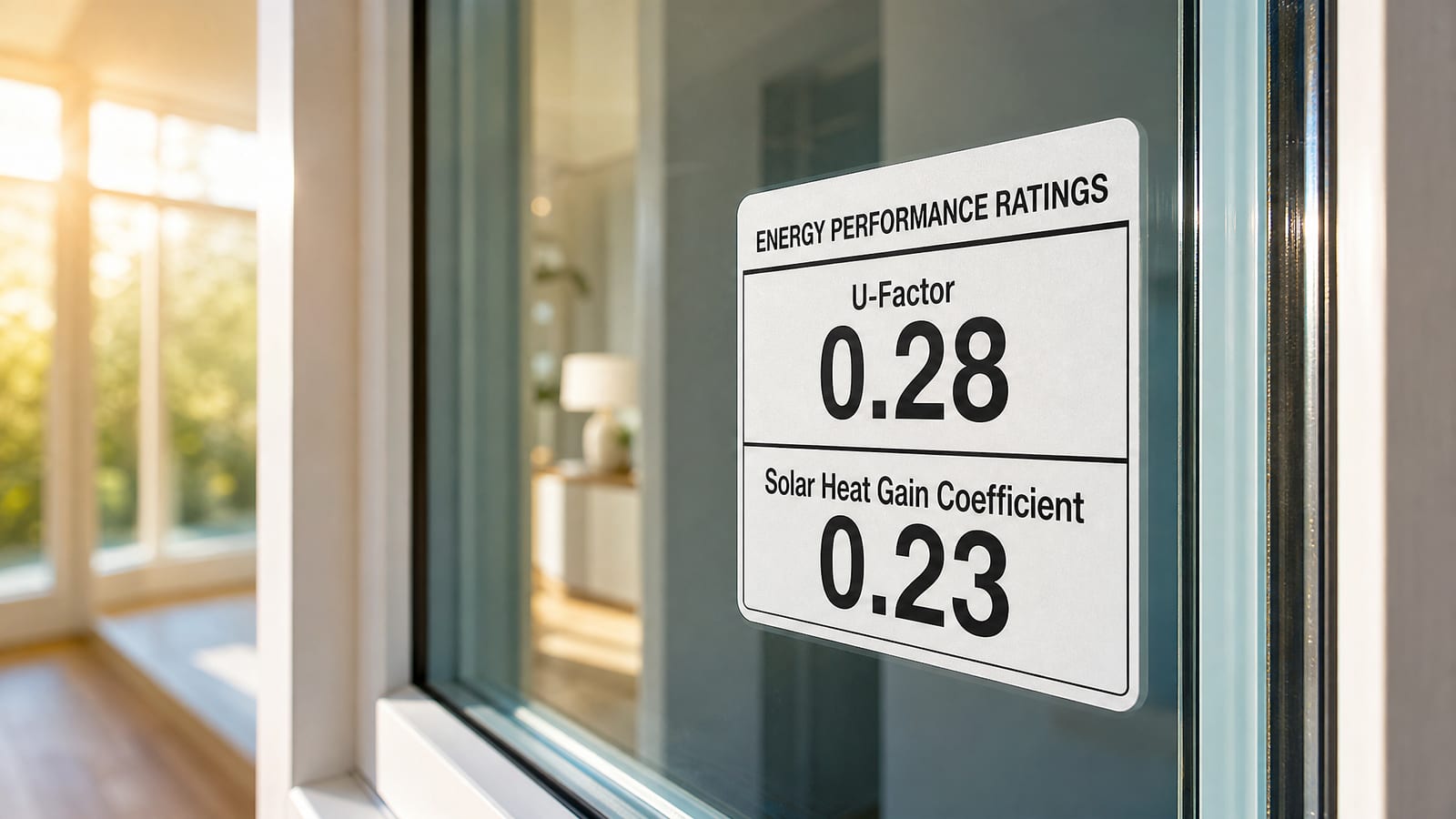
- Ask for the NFRC numbers for the exact line and glass package on your quote. Two quotes that both say “meets Idaho energy code” can be very different windows.
The full label decode — what U-factor and SHGC each measure, and how to read the sticker — is on the energy-ratings page. And if cold glass is the reason you’re shopping at all, condensation has its own guide: the fix is often free, and it isn’t always new windows.
Sources, Verification & Fact-Checking verified July 2026
Every load-bearing fact on this page is sourced and verified against a primary authority.
Verified July 2026 via direct review of the cited authority — the links open the controlling source so you can check it yourself rather than take our word.
- Idaho’s amended energy code sets a maximum fenestration U-factor of 0.32 in Climate Zone 5 and 0.30 in Climate Zone 6, skylights at 0.55 in both, and lists SHGC as “NR” (not required). The amendment replaces the Zone 5/Marine 4 and Zone 6 rows of 2018 IECC Table R402.1.2. (view source — IDAPA 24.39.30, Rules of Building Safety)
- Idaho amended Climate Zone 5 upward from the 2018 IECC base of 0.30 to 0.32 — a looser requirement than the national baseline. Zone 6 remains at 0.30. (view source — IDAPA 24.39.30 · view source — 2018 IECC Table R402.1.2 base values)
- Idaho is a two-zone state — 5B and 6B — with no county assigned to Climate Zone 7. Ada, Canyon, Kootenai and Nez Perce counties are 5B; Valley, Blaine, Bonner and Boundary counties are 6B. (view source — DOE/PNNL, Guide to Determining Climate Regions by County)
- All Idaho ZIP codes fall within the ENERGY STAR “Northern” climate zone. (view source — ENERGY STAR V7 climate-zone assignments by ZIP and county)
- The 2024 I-Codes are proposed in Idaho but not in force; the amended 2018 IECC remains the adopted energy code. (view source — Idaho DOPL building-code rule redlines)
- An Idaho local jurisdiction cannot adopt a newer edition of the energy code than the state has adopted. (view source — Idaho Code § 39-4116)