


Here is the most useful thing I can tell you about window prices in Idaho, and it’s the thing no cost site will say: there is no authoritative price index for replacement windows in this state. None. Every number you’ve seen online is a national guide’s range, a computer model, or a contractor’s own published figures.
I went looking for the real Idaho number. What I found instead was the spread — and the spread turns out to be far more useful than any single number, because once you can see it, you can read a quote instead of trusting an average.
The short version: across every source that actually covers Idaho, a typical installed replacement window lands somewhere between roughly $400 and $1,100. National guides put their own averages anywhere from $477 to $800. That’s not a satisfying answer. It is, as far as I can verify, the true one.
Why can’t anyone tell me what a window costs in Idaho?
Because nobody is measuring it. There’s no state survey, no published transaction data, no index. What exists online is three different species of number, and they all wear the same dollar sign:
| Kind of number | Example | What it actually is |
|---|---|---|
| National cost-guide range | $450–$1,200 typical, avg $800 (Fixr) · avg $477, surveyed homeowners mostly $232–$740 (This Old House) | Broad national data, regularly updated — but not Idaho |
| Modeled regional estimate | $380–$1,100 per window, Idaho (buildcost.io) | A labor-index calculation, not observed prices |
| A local contractor's published range | $350–$600 standard vinyl, Boise (Iron Crest) | Real local market knowledge — and also marketing |
National cost-guide range
- Example
- $450–$1,200 typical, avg $800 (Fixr) · avg $477, surveyed homeowners mostly $232–$740 (This Old House)
- What it actually is
- Broad national data, regularly updated — but not Idaho
Modeled regional estimate
- Example
- $380–$1,100 per window, Idaho (buildcost.io)
- What it actually is
- A labor-index calculation, not observed prices
A local contractor's published range
- Example
- $350–$600 standard vinyl, Boise (Iron Crest)
- What it actually is
- Real local market knowledge — and also marketing
Here’s the part that surprised me when I traced it. A lot of what circulates online as “Boise window prices” — the vinyl bands, the whole-house ranges, a “$13,500 Boise median” — traces back largely to one Boise remodeling contractor’s own cost guide, quoted and re-quoted until it looks like consensus.
That contractor knows the local market and publishes genuinely useful numbers. But one company’s price sheet repeated five times is still one company’s price sheet, not five sources agreeing.
None of this means the sites publishing numbers are doing anything wrong. It means the question “what does a window cost in Idaho” has no single answer, and the sources that seem to give one are answering an easier question.
The spread, laid out honestly
So what can be said? Here’s everything I could verify, with each figure labeled by what it is:
- National, with a survey behind it: This Old House puts the average at $477 per window (range $395–$631), with surveyed homeowners mostly paying $232–$740. That’s the closest thing to real transaction data that exists.
- National cost guide: Fixr’s typical installed range is $450–$1,200, averaging $800. Vinyl runs $350–$800, fiberglass $400–$1,500, wood $600–$2,000.
- Modeled for Idaho: buildcost.io’s regional labor-index model puts an Idaho window at $380–$1,100 installed. It’s a calculation, not a survey — but it’s an Idaho calculation.
- Local Boise figures: the contractor guide above lists standard double-pane vinyl with Low-E at $350–$600. A Boise city cost page from 2024 had standard vinyl double-hung at $400–$500 installed. Both fit inside the national spread.
Notice what those figures do: they overlap and roughly agree at the per-window level. Where everything falls apart is whole-house totals.
Three sources describing overlapping project sizes produce whole-house centers of about $6,600, about $13,500, and $12,000–$24,000. Those don’t even touch. The reason is simple — a “whole house” is 8 windows or 28 windows, inserts or full tear-outs, vinyl or wood-clad.
drawn to scale
The same sources, two very different pictures
Every verified figure from the list above, on a real dollar axis — per window first, then whole-house.
Per window: the sources overlap and roughly agree
This Old House — surveyed homeowners$232–$740
Fixr — typical installed range$450–$1,200
buildcost.io — Idaho model$380–$1,100
Boise contractor guide — standard vinyl$350–$600
Boise city cost page (2024) — vinyl double-hung$400–$500
Whole house: where everything falls apart
Three sources describing overlapping project sizes:
One source's whole-house centerabout $6,600
A second source's centerabout $13,500
A third source's range$12,000–$24,000
A whole-house price without a window count is a number without a meaning. If you take one sentence from this page into your quotes, take that one.
How to read a window quote — the four lines that matter
This is the part no aggregator will do for you, and it’s worth more than any price band. A good itemized quote answers four questions. If yours doesn’t, ask for a version that does — any serious installer can produce one.
1. The per-window unit price. Not the project total — the price per opening, per window line. This is the only number you can compare across quotes and against the bands above. If a quote only shows a lump sum, you can’t tell whether you’re paying for better windows or just paying more.
2. The labor line. Nationally, labor on a standard opening runs about $150–$300 per window, more for bays, bows, and anything structural. Across sources, labor is somewhere between roughly a third and a little under half of the installed price. A quote that breaks labor out is a quote you can interrogate. One that buries it is asking you to compare blind.
3. The glass package. Two quotes that both say “vinyl double-hung” can be very different windows. What’s the U-factor on the NFRC label for the exact glass package quoted? Is it Low-E? Argon fill? Idaho’s code allows up to 0.32 in Climate Zone 5 — and as I covered in the Idaho energy-code guide, that’s a floor, not a target. The glass package is where a few hundred dollars per window quietly lives.
4. The install method. Insert (pocket) replacement keeps your existing frame and trim. Full-frame replacement tears out to the rough opening and redoes flashing and insulation around the window. Full-frame costs meaningfully more per opening and is sometimes genuinely necessary — rot, bad original install, changing the opening. The quote should say which one you’re buying. If it doesn’t, the two quotes on your table may not be for the same job.
The three cost facts I’d actually lean on
Out of everything I traced for this page, three figures survived verification with independent support. In a subject this soft, that makes them the load-bearing facts:
The foggy-glass fix: roughly $150–$600, versus $600–$1,500+ for full replacement. Fog between the panes you can’t wipe off means the insulated glass unit — the IGU, the sealed sandwich of glass — lost its seal. On many windows, a glass shop can replace just the IGU without touching frame or trim. Two independent national guides bracket that fix at $150–$600 including labor. Full replacement of the same window starts around $600 and climbs past $1,500.
One homeowner put it more bluntly than any guide: “most foggy windows are a $300 fix.” That’s one person’s price, not a band — but it sits comfortably inside both verified ranges. If your frames are sound, price the repair before anyone prices the replacement. There’s a full walkthrough of fog, seals, and when repair makes sense in the condensation guide.
The triple-pane upcharge: +$150–$300 per window. A Boise contractor publishes that band, and an independent national survey lands at +$171 — right inside it. That corroboration makes this the single best-supported cost figure in Idaho. Whether triple-pane is worth it is a separate question about comfort, noise, and how cold your side of the state gets. But at least the price of the question is known.
Labor on a standard opening: about $150–$300 per window. Useful mostly as a sanity check on line 2 of your quote.
Everything softer than these three — fiberglass-versus-vinyl percentages, full-frame upcharge percentages, “Boise median” figures — either traces to a single commercial source or to nothing I could find. So I’m not printing them as facts.
The one hard-money table in Idaho: Avista’s rebate
Now for the confirmed money. If your electric or gas bill comes from Avista — the utility serving much of northern Idaho — there is a real per-window rebate, verified on Avista’s own page in July 2026, and it has a trap built into it that I haven’t seen anyone else mention.
One honest caveat first: Avista doesn’t publish its Idaho boundary at a county level, and parts of the panhandle are served by electric co-ops instead. The name on your utility bill is the test, not your town.
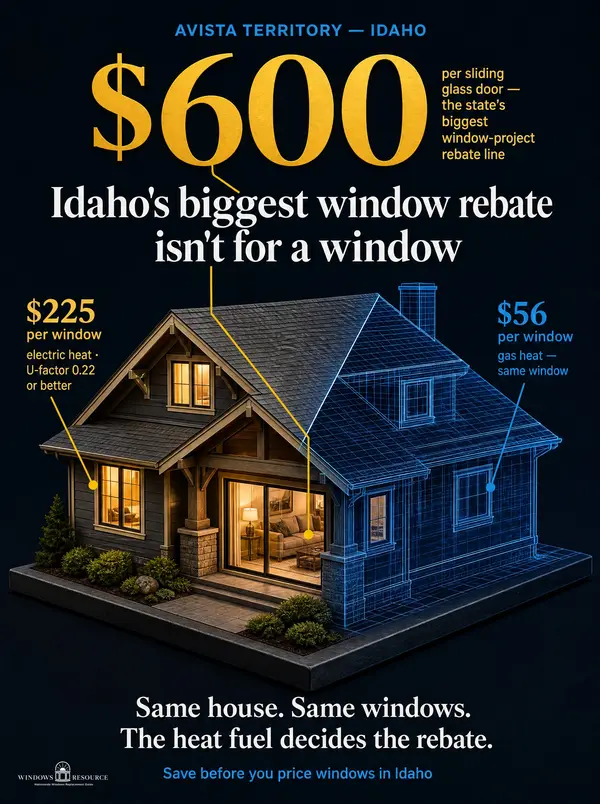
The rebate depends on how your home is heated:
| Install & U-factor | Electric-heated home | Natural-gas-heated home |
|---|---|---|
| Contractor install, U 0.29–0.23 | $180 / window | $45 / window |
| Contractor install, U ≤ 0.22 | $225 / window | $56 / window |
| Self-install, U 0.29–0.23 | $90 / window | $22 / window |
| Self-install, U ≤ 0.22 | $112 / window | $28 / window |
Contractor install, U 0.29–0.23
- Electric-heated home
- $180 / window
- Natural-gas-heated home
- $45 / window
Contractor install, U ≤ 0.22
- Electric-heated home
- $225 / window
- Natural-gas-heated home
- $56 / window
Self-install, U 0.29–0.23
- Electric-heated home
- $90 / window
- Natural-gas-heated home
- $22 / window
Self-install, U ≤ 0.22
- Electric-heated home
- $112 / window
- Natural-gas-heated home
- $28 / window
And one more Avista line that deserves to be famous:
The fine print that’s confirmed: existing homes only, a usage screen applies (at least 4,000 kWh or more than 120 therms in the last 12 months), and the application must go in within 120 days of install.
Everywhere else in Idaho: the honest rebate map
Avista is the exception, not the rule. Here’s the rest of the state, verified against each utility’s own pages:
Treasure Valley (Boise, Meridian, Nampa, Caldwell) — Idaho Power has no residential window rebate. I want to say that plainly because aggregator sites keep implying otherwise. Idaho Power’s residential offers cover heating/cooling, an A/C credit, and shade trees. The only window-related channel is a weatherization program for income-qualified households — free upgrades up to $6,000 in value, applied for through your regional Community Action Partnership agency, electric-heat homes only.
What the Treasure Valley does have is the state loan. Idaho’s Office of Energy and Mineral Resources runs a low-interest energy loan — 3% over 3 years, 5% over 5, 7% over 7, up to $40,000 — and window and door replacements qualify when they meet ENERGY STAR Northern climate zone criteria. All of Idaho is in the Northern zone, so that’s the spec to ask your installer for.
It’s statewide, first-come-first-served until funding runs out or the end of 2026, and it requires a deed and a credit check. It is a loan you repay — not a rebate.
But it’s real, and it’s the honest Boise-area answer.
Eastern Idaho — Rocky Mountain Power pays $40 per window on electrically heated homes ($15 if the home qualifies through central cooling or a dual-fuel heat pump instead), and only at U-factor 0.22 or better with professional installation. Apply within 90 days.
Idaho Falls — Idaho Falls Power pays $12–$16 per square foot of glass on electrically heated homes, and requires their free energy consultation before you purchase. The replacement windows must hit U-factor 0.30 or better. There’s also a 0% loan option in place of the rebate.
Kootenai County co-op members: Kootenai Electric’s program list includes windows and patio doors for existing homes, but I could not verify the rebate amount on any page of theirs — the figure that circulates online comes from third-party aggregators, so I won’t print it. Call them at (888) 883-9879 before you count on a number.
And the federal tax credit is gone. The Section 25C credit covered qualifying windows placed in service through the end of 2025. It has expired, with no successor. A 2026 sales pitch that leans on “the federal tax credit” for windows is working from an old script — politely ask to see the current IRS page.
What I’d actually do with all this
If I were pricing windows in Idaho this year, here’s the sequence:
- Check the repair door first. Foggy glass in a sound frame is a $150–$600 conversation, not a $600–$1,500 one.
- Get three itemized quotes — you already knew that, and you’re right — and make each one show the four lines: unit price, labor, glass package, install method.
- Compare per-window prices only. Refuse to compare whole-house totals across different window counts or install methods.
- Look up your own utility’s rebate page the same week you sign — amounts on this page were verified in July 2026 and rebate tables change with little notice. Avista’s page carries its own change notices, and Rocky Mountain Power reserves the right to change rebates on 45 days’ notice.
- Treat every band on this page as a planning band, not a quote. The only real number is the written line-item quote in front of you.
The window that goes into that quote matters as much as the price on it. For what the glass package numbers mean, start with the Idaho energy-code guide — and if a Milgard line is on your quote, as it will be in much of Idaho, the Milgard review covers what their warranty fine print actually says.
Sources, Verification & Fact-Checking verified July 2026
Every load-bearing fact on this page is sourced and verified against a primary authority.
Verified July 2026 via direct review of the cited authority — the links open the controlling source so you can check it yourself rather than take our word.
- National cost guides put a typical installed replacement window at $450–$1,200 (average $800), with vinyl $350–$800, fiberglass $400–$1,500, wood $600–$2,000, and labor $150–$300 for standard openings. (view source — Fixr window replacement cost guide, updated January 2026)
- A national guide with a homeowner-survey component reports an average of $477 per window (range $395–$631), surveyed homeowners mostly paying $232–$740, and double-pane at $490 vs triple-pane at $661 — a +$171 difference. (view source — This Old House window replacement cost, updated June 2026)
- A modeled Idaho estimate puts an installed window at $380–$1,100 (regional labor-index model, not observed prices). (view source — buildcost.io Idaho window replacement model, May 2026)
- A Boise contractor’s published guide lists standard double-pane vinyl with Low-E at $350–$600 and a triple-pane upcharge of +$150–$300 per window. Cited as a local commercial source, not a survey. (view source — Iron Crest window replacement cost guide, Boise)
- A Boise city cost page (2024) lists a standard vinyl double-hung at $400–$500 installed. (view source — HomeBlue Boise window replacement cost, published September 2024)
- Glass-only IGU replacement runs roughly $150–$600 including labor, versus $600–$1,500+ for full window replacement. (view source — Fixr window glass replacement cost · view source — Modernize glass replacement cost guide)
- Avista’s Idaho single-family window rebate: contractor install $180/window (U 0.29–0.23) or $225/window (U ≤ 0.22) for electric-heated homes; $45/$56 for gas-heated homes; self-install $90/$112 electric, $22/$28 gas; sliding glass doors up to $600/door contractor-installed on electric-heated homes at U ≤ 0.22. Existing homes only, Avista primary heat, usage screen, 120-day application window. (view source — Avista Idaho windows rebate page)
- Idaho Power has no residential window rebate; its residential offers are limited to heating/cooling efficiency, an A/C bill credit, and a shade-tree program. (view source — Idaho Power residential rebates and offers)
- Idaho Power’s income-qualified weatherization program provides free upgrades including new windows and doors, up to $6,000 in value, for electric-heat homes, applied for through regional Community Action Partnership agencies. (view source — Idaho Power weatherization programs)
- Idaho’s State Energy Loan Program offers 3%/3-year, 5%/5-year, and 7%/7-year loans up to $40,000; windows and doors qualify when they meet ENERGY STAR Northern climate zone requirements. (view source — Idaho OEMR State Energy Loan Program)
- Rocky Mountain Power’s Idaho wattsmart window rebate is $40/window for electrically heated homes ($15 for cooling-qualified homes), at U-factor ≤ 0.22 with professional installation, applied for within 90 days; rebates subject to change with 45 days’ notice. (view source — Rocky Mountain Power wattsmart Idaho windows)
- Idaho Falls Power pays $12–$16 per square foot of window glass replaced on electrically heated homes, requires a free energy consultation before purchase, and requires replacement windows at U-factor ≤ 0.30; a 0% loan up to 60 months is available in lieu of the rebate. (view source — Idaho Falls Power insulation and windows program)
- The federal Section 25C Energy Efficient Home Improvement Credit applies only to qualifying property placed in service before December 31, 2025 — it has expired for 2026 installations. (view source — IRS, Energy Efficient Home Improvement Credit)